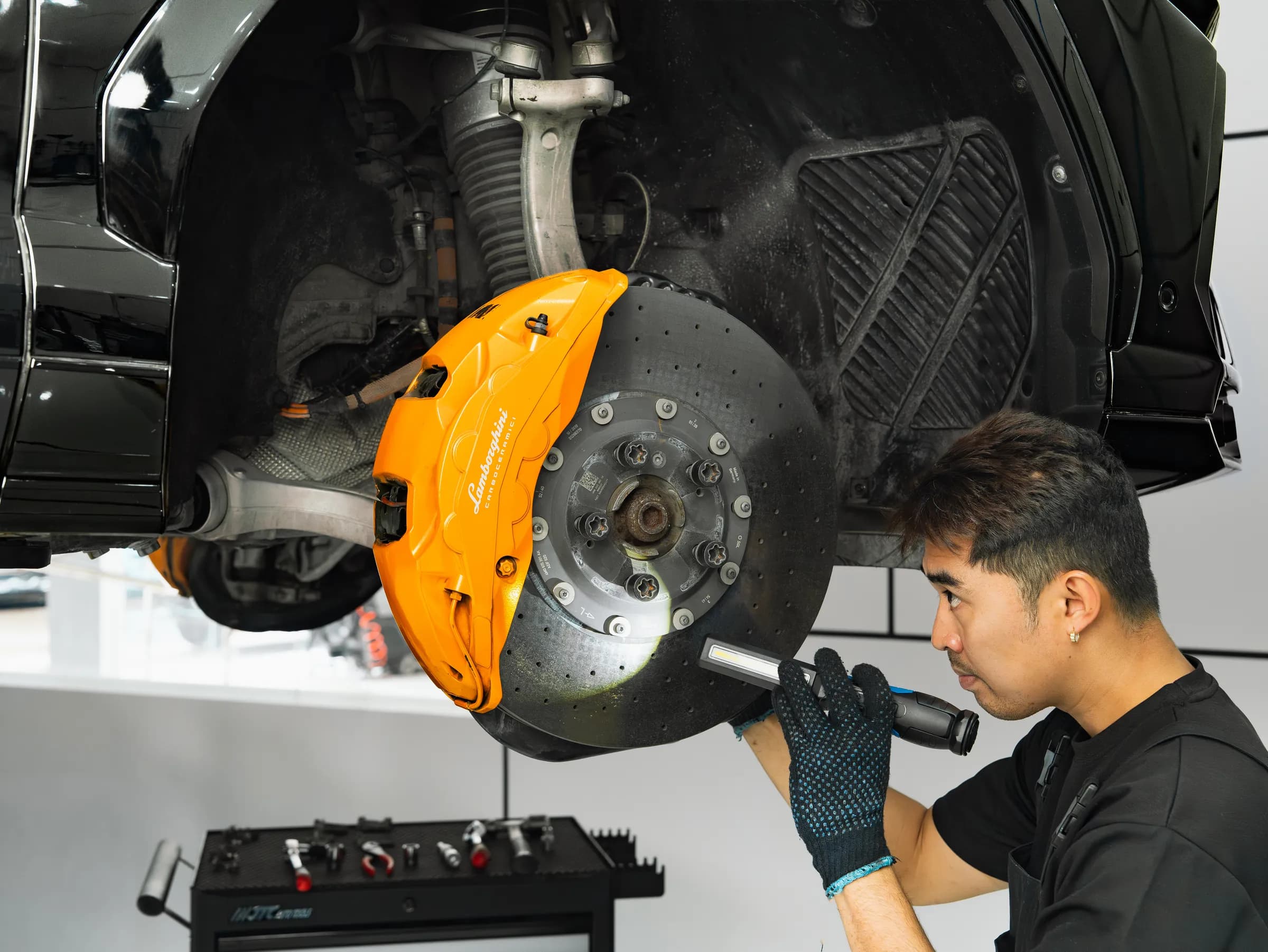

Last Tuesday, a client brought a Ferrari F8 Tributo to Luxury Auto Care Dubai in Al Quoz after a weekend drive to Hatta. The air conditioning had stopped working halfway through the trip. The engine warning light was on. When we plugged in the diagnostic scanner, the coolant temperature sensor was reading 112°C. In normal conditions, that engine should never exceed 95°C.
This is what Dubai summers do to luxury cars. The ambient temperature was 47°C that day. The road surface temperature was over 60°C. Every component on the car was operating at its thermal limit. And this was a car that had been serviced just three months ago.
The truth is, most luxury car owners in Dubai treat summer like any other season. They drive the same way, park the same way, and maintain the same schedule. But the reality is that 50°C heat changes everything. It changes how your engine cools, how your tyres perform, how your battery holds charge, and how your paint holds up. If you are not adjusting your maintenance routine for summer, you are gambling with a car that costs more than most people's houses.
Here is what we tell every client who walks through our doors in June. These are the five things that matter most.
1. Engine Cooling System: The First Thing That Fails
Every supercar we see in summer has one thing in common: the cooling system is working harder than it was designed to. A Ferrari 488 GTB generates around 660 horsepower. That power creates enormous heat. In Maranello, the average summer temperature is 30°C. In Dubai, it is 47°C. That is a 17°C difference in ambient temperature that the cooling system has to compensate for.
What happens is gradual. The coolant degrades. The water pump impeller wears. The thermostat starts sticking. None of these things trigger a warning light until it is too late. By the time you see the temperature gauge climbing, you are already in trouble.
We recommend a full coolant flush every 6 months in Dubai, not the 12-month interval that most manufacturers specify. The reason is simple: Dubai's heat accelerates coolant degradation. The corrosion inhibitors break down faster. The heat-transfer properties decrease. You end up with a cooling system that looks fine on paper but cannot handle the thermal load.
The second thing we check is the expansion tank and hoses. Heat cycling causes rubber and plastic components to become brittle. We have pulled expansion tanks off cars that looked perfect on the outside but had hairline cracks on the inside. On a 47°C day, that crack becomes a leak. That leak becomes a breakdown on Sheikh Zayed Road.
2. Tyre Pressure and Condition: Where Physics Meets Reality
Tyres are the most underestimated summer risk on a luxury car. Here is the math. At 25°C, your tyres are at the correct pressure. For every 10°C increase in ambient temperature, tyre pressure increases by approximately 1 PSI. In Dubai, where road surface temperatures can exceed 70°C, that means your tyres can gain 4 to 5 PSI above the recommended pressure just from heat.
Now add the heat generated by driving. A Porsche 911 GT3 RS on a highway run at 140 km/h generates significant friction heat in the tyres. Combined with the ambient temperature, you are looking at tyre temperatures of 80°C or more. At those temperatures, the rubber compound changes behaviour. It becomes softer. Grip characteristics change. Sidewall flex increases.
The danger is not just about pressure. It is about the compound. Summer tyres sold in Europe are designed for temperatures up to about 35°C. Dubai regularly exceeds that. For supercar owners, we recommend checking tyre pressure every morning before driving, when the tyres are cold. Not at the petrol station after a 30-minute drive. The reading will be wrong.
We also recommend having the alignment checked before summer. Heat affects tyre wear patterns differently than cold. A car that tracked perfectly in February might pull to one side in July if the alignment was marginal. That uneven wear becomes dangerous when combined with the thermal stress.
3. Air Conditioning: Not a Luxury, a Necessity
Here is something most people do not realise: your car's air conditioning system is under the most stress in summer. Not just because it is cooling the cabin, but because the entire refrigeration cycle is less efficient when ambient temperatures are high.
A Lamborghini Urus with a cabin temperature of 55°C after sitting in the sun needs the AC system to remove enormous amounts of heat. The compressor runs at maximum capacity. The condenser is trying to reject heat into 47°C air. The system is operating at the edge of its design limits.
The most common failure we see is a slow refrigerant leak. These leaks are almost impossible to detect at room temperature. The seals contract when cold and expand when hot. A seal that holds perfectly in a workshop at 22°C will weep refrigerant at 50°C. Over weeks, the system loses charge. Performance drops. The driver does not notice until one day the AC stops working completely.
We recommend an AC performance check every 3 months in summer. This is not just a gas top-up. We check the compressor output, the condenser condition, the evaporator temperature, and the blend door operation. A full diagnostic takes about 45 minutes and catches problems before they become breakdowns.
4. Paint and Body Protection: Dubai's UV and Sand
Dubai's sun is brutal on paint. The UV index regularly exceeds 11 in summer. Combined with the fine desert sand that is constantly in the air, your car's paint is being sandblasted and UV-faded at the same time.
For owners who park outside, ceramic coating is the minimum. A proper ceramic coating creates a sacrificial layer that absorbs the UV damage and provides hydrophobic properties that make sand and dust easier to remove. But not all ceramic coatings are equal. A 9H hardness coating applied correctly will last 2 to 3 years. A cheap wax marketed as ceramic will last 6 months.
Paint protection film is the next level. For cars that are driven daily, PPF absorbs the stone chips and sand abrasion that would otherwise damage the clear coat. On a Ferrari or Lamborghini, a respray of a single panel can cost AED 8,000 to AED 15,000. A full-front PPF installation costs around AED 6,000 to AED 12,000 depending on the car. The math is simple.
The mistake we see is owners waiting too long. By the time the paint shows swirl marks and oxidation, the damage is done. Prevention is always cheaper than correction.
5. Battery and Electrical: The Silent Killer
Heat kills car batteries faster than cold. This surprises people because most battery advice focuses on winter. But the chemistry is clear: high temperatures accelerate the chemical reactions inside the battery. A battery that would last 5 years in Germany will last 3 years in Dubai.
For supercars, the problem is compounded. Cars like the Bentley Continental GT or Rolls-Royce Ghost have extensive electronic systems. Multiple ECUs, comfort modules, ambient lighting systems, heated and cooled seats. These systems draw standby current even when the car is off. In summer, when the battery is already stressed by heat, that standby drain can push a marginal battery over the edge.
We test every car's battery health as part of our summer inspection. We measure the resting voltage, the cranking amps, and the internal resistance. If the battery is more than 3 years old, we recommend replacement before summer, not after. A dead battery in a Ferrari at 2am in Dubai Marina is not the kind of evening anyone wants.
The Bottom Line
Dubai's summer is not forgiving. The heat, the sand, the UV, the humidity. Everything is working against your car. The vehicles that survive Dubai without issues are the ones that are maintained properly, on a schedule that accounts for the climate.
A quarterly maintenance check in summer is not excessive. It is the minimum. Every system on the car is operating under more stress than the manufacturer intended. Catching problems early is the difference between a routine service and an emergency recovery.
If you have not had your car checked this summer, now is the time. The temperatures are only going up from here.